Why does the IQOS UK subscription service make you want to unsubscribe?
2026-04-08
This is a textbook example of a service designed around the operational convenience of the business, not around actual customer behaviour.
- Ecommerce
- Subscription
- Case Study
- UX
Short answer: The service creates more inconvenience for the user than it delivers in value. Below, I will explain why.
This is a textbook example of a service designed around the operational convenience of the business, not around actual customer behaviour. A subscription is a retention tool. But when a subscription creates more friction than it removes, the customer does not subscribe.
Hi, I am Hlib, and I'm a Senior Ecommerce executive with nearly two decades of experience in digital transformation, building global ecommerce operations, implementing digital services, and delivering exceptional customer experience. Former Chief Digital Officer at Pandora.
Below is a case study from my personal experience as a customer of the IQOS UK subscription service by Philip Morris International. Relying on research and the best Customer Experience practices, I'll explain, step by step, why I think it doesn't work and how to fix it.
What IQOS UK is aiming for
IQOS UK directs nearly all of its efforts towards acquiring new customers for its own D2C channel. It is unlikely they are targeting an entirely new audience, since advertising tobacco products is prohibited. So the focus is on consumers who currently buy consumables elsewhere, such as supermarkets, corner shops, or other services.
The objective is perfectly clear: by selling the product directly to the end consumer, the business stands to gain a significant increase in margin as the primary effect, and greater control over the market and the customer as a secondary one.
Why do I say that IQOS UK directs nearly all of its efforts towards acquisition rather than retention of existing customers? It is transparently visible from their actions. When the customer lands on the homepage, it immediately greets him with four messages, all of which relate exclusively to a new audience:
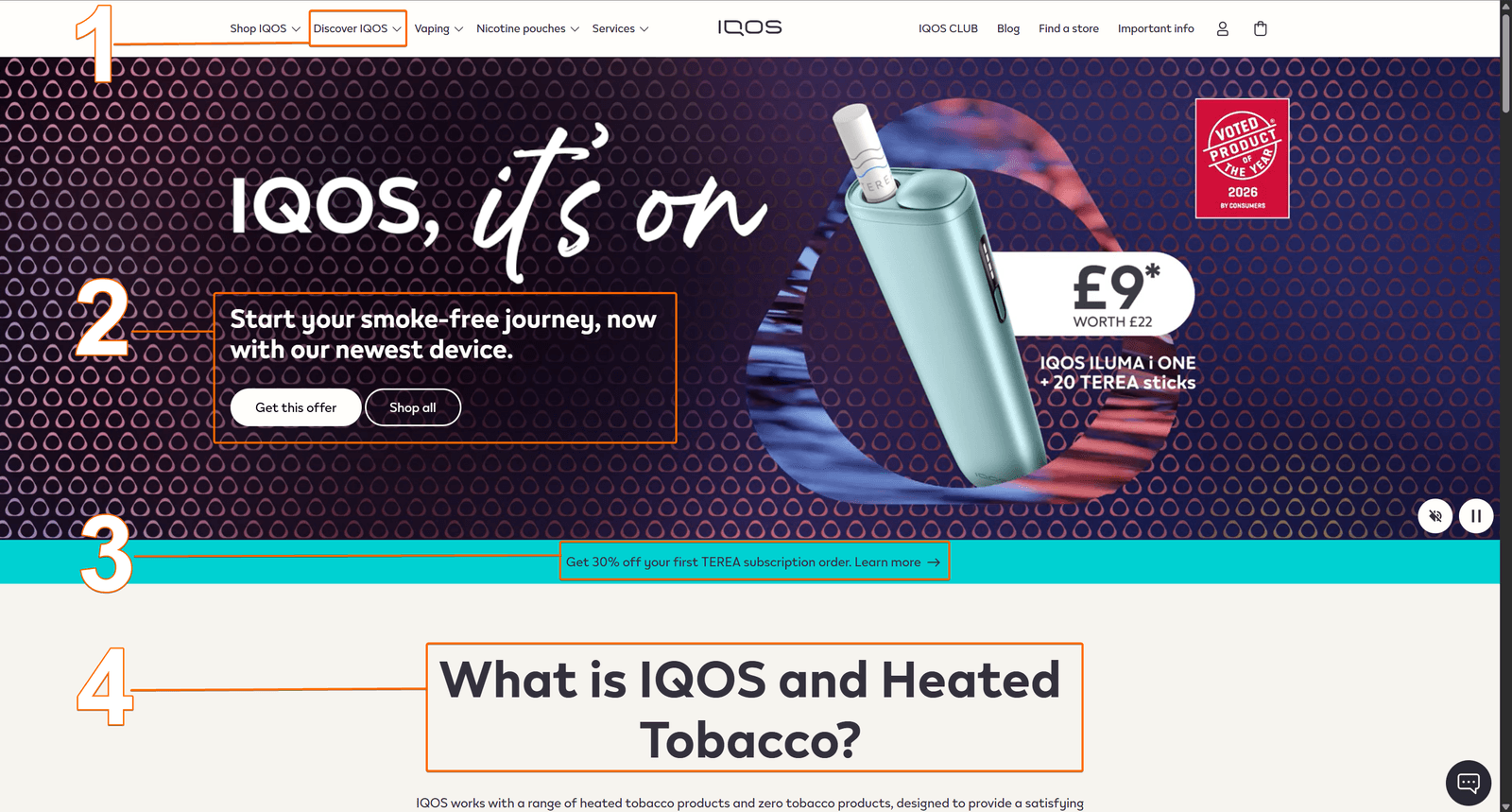
2: offers a price deal on the device for new customers only.
3: is meant to encourage both existing and new customers to subscribe to consumables, but the 30% off does not always work. I'll explain it further in this study.
If you scroll further, the entire homepage is oriented exclusively towards new customers, expanding on the topics established on the first screen.
You might object and say: "Hlib, if you are a logged-in customer, it will look different and there will be value for you as a returning customer!"
I assure you, the page will remain the same.
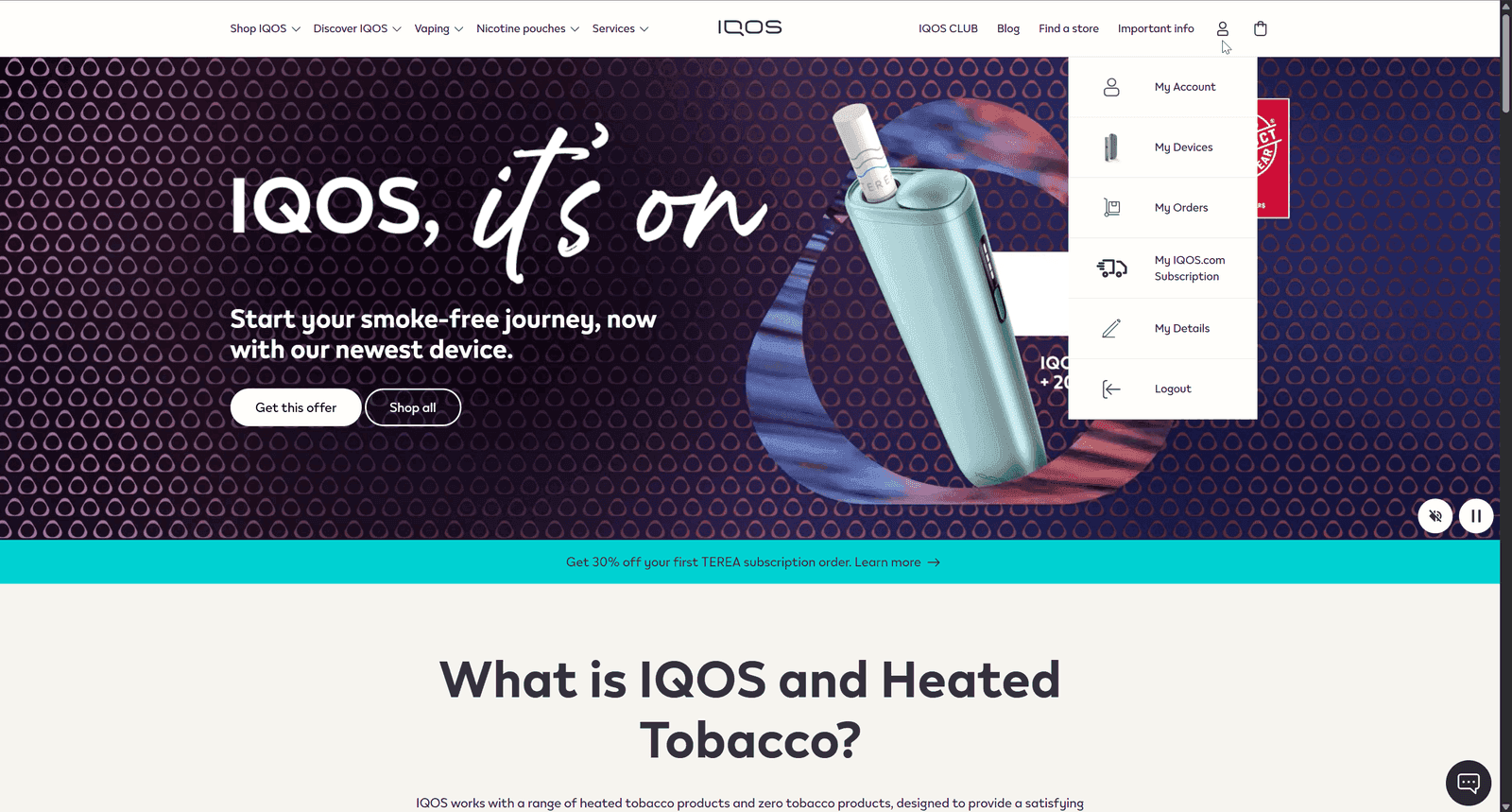
What IQOS UK offers existing customers to keep them loyal
Philip Morris International has the IQOS Club programme, which offers 5%, 7%, and 10% discounts on consumables. To become a member of the loyalty programme, the customer needs to create an account on the website, then find the IQOS Club landing page, which is linked in the header and footer. On mobile devices, the link sits behind the burger menu in the header, in secondary focus, and in the footer. Once the customer has reached the landing page, they need to press a separate button to enrol in the loyalty programme.
Once all of this is done, the customer unlocks:
- 5% off immediately upon joining.
- 7% off after cumulative spending of £3,000+, which equals 451 packs of Terea sticks worth £6.65 each with a previous tier discount.
- 10% off after spending £6,000+, which equals 461 packs of Terea sticks worth £6.51 each with a previous tier discount.
912 packs of sticks need to be purchased to reach top-tier membership in the loyalty programme. As my research shows, most IQOS customers consume between 7 and 20 sticks per day. With continuous use and purchasing consumables exclusively direct from IQOS, customers would reach the 10% discount somewhere between 912 and 2,605 days, or roughly 2.5 to 7 years. I will halve these timeframes, because the customer also has opportunities to proactively earn additional points that accelerate the transition to the next tier. That means that the customer can achieve a top tier in a period from just over a year to 3.5 years. The customer needs to be very loyal to the brand and remain with it for this long. However, at any tier, you can earn a £100 certificate by bringing a friend through the referral programme, which is a significant amount in the market. It is worth noting that this certificate is available across all tiers, including non-members of the loyalty programme, with the reward identical for everyone. This is also an unusual proposition in a market where, typically, the referral reward increases with membership tier.
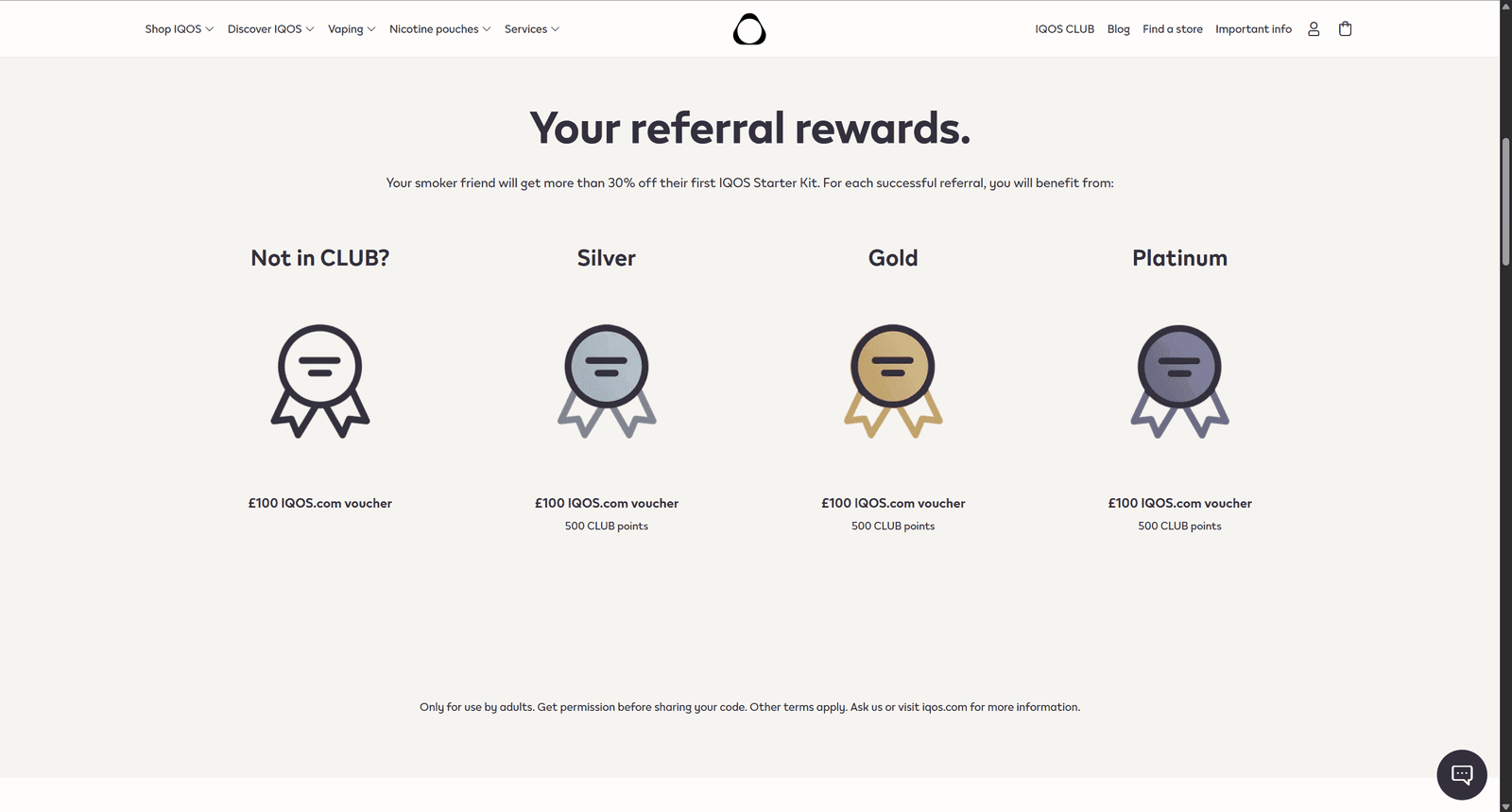
Based on the observations above, I draw an unambiguous conclusion: the majority of Philip Morris International's efforts are directed toward acquiring a new audience for its own D2C, one that must be pulled from other third-party channels.
The subscription that makes you want to cancel it
IQOS is a business that needed a consumables subscription feature yesterday. Because the money is there, the device is the entry point. The profit is in the sticks and pods.
If you were to rank product categories where a regular delivery subscription is an absolute necessity, the list would include baby nappies, pet food, and contact lenses. Smoking consumables sit firmly in the same tier. The list is not exhaustive, of course, but the point is clear: this is a category where subscription is not a "nice to have" but a must-have.
And so, around early 2026, IQOS UK finally delivers a subscription option. And you would think – brilliant. Set it up, forget about it, get on with your life. Maybe adjust the delivery frequency once or twice.
Not quite.
The arithmetic that does not add up
IQOS offered me three delivery frequency options: every two weeks, every month, or every two months.
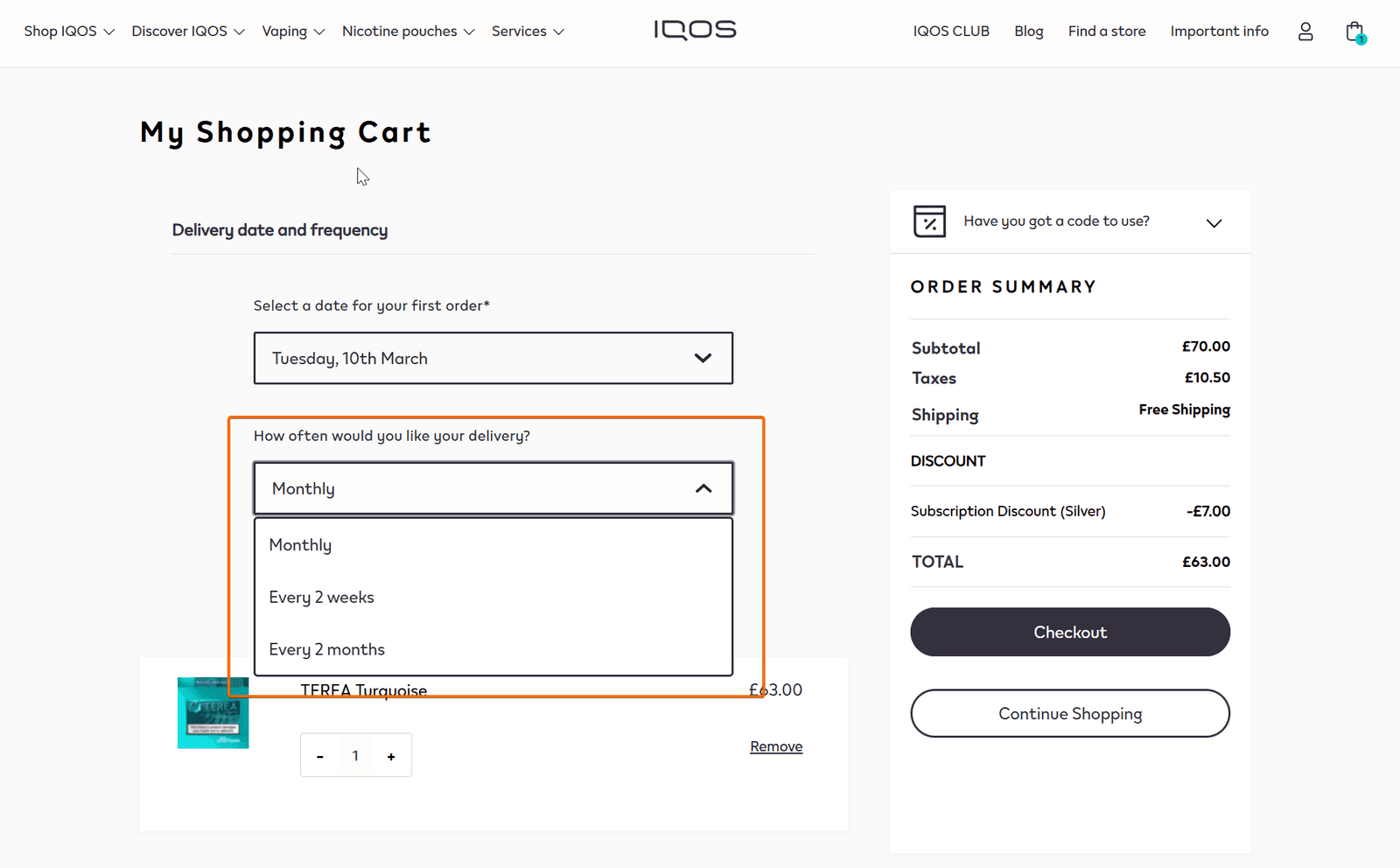
Sticks are sold exclusively in bundles. A bundle contains 10 packs of 20 sticks each – 200 sticks total. Now, research suggests the average IQOS user consumes around 11-13 sticks per day. At that rate, one bundle lasts roughly 15-18 days, which more or less aligns with the two and four-week delivery cycles. So far, so reasonable.
But "average" is doing a lot of heavy lifting in that sentence.
The most recent research on tobacco consumption in the United Kingdom shows that the 11-13 sticks-per-day figure represents a group of fewer than 13% of all customers; meanwhile, more than half consume fewer per day, and roughly 20% consume closer to 20 sticks per day. I fall into the latter group. At that rate, one bundle lasts for 10 days. Two weeks is 14 days. Does not add up.
Two bundles would give me 20 packs. Two weeks is still 14 days. Overshoot.
Meanwhile, plenty of lighter users at 8-9 sticks per day would need a bundle roughly every three weeks – an interval the subscription does not offer either.
In other words, delivery frequency options appear to be calibrated around the statistical average, which, as averages tend to do, conveniently represents almost nobody in particular. The subscription caters to the midpoint on a chart rather than to the actual consumption patterns of most real customers.
Three bundles once a month? The maths finally works for heavier users, but:
- That is, if we are talking about a static figure again. If a customer consumes 18 or 22 sticks per day, this schedule no longer works.
- A month could be a far too long a planning horizon for a daily consumable. If I am not home on delivery day, I am out of sticks.
Weekly or preferred delivery frequency? Those options do not exist. And this is given that a change in consumption of just two sticks per day already significantly shifts the required delivery schedule for each individual consumer.
And I am fairly convinced I know why: a single bundle already qualifies for free next-day delivery under IQOS UK's T&C. Weekly shipments would eat into the margin. So the customer is "encouraged" to order less frequently and in larger quantities.
The business logic is clear. The customer logic is equally clear: under these conditions, the percentage of users willing to switch from their current channel to PMI's D2C would shrink.
Perhaps because the only tangible benefit of subscribing is an additional 5% discount on top of the one customers already have. Five per cent. That is it. The subscription solves none of the other customers' headaches. If anything, it complicates the process compared to simply buying a single bundle of sticks whenever it suits me via the IQOS website or at the corner shop on my way home from the office.
And a separate point: I was promised an additional 20% discount at checkout on my first subscription delivery. The discount never appeared (when I was writing this text, the terms of the additional discount did not mention any requirement to use a promo code, as they do now). So effectively, I was misled at the point of acquisition. Not the strongest foundation for a long-term customer relationship.
One step forward, two clicks to bypass, one subscription gone
IQOS implemented the ability to adjust the date of the next delivery.
Website > month and year of birth > Login > Account > My subscriptions > Edit your order > Adjust the date of your next delivery > choose the date > Save.
9 steps. A slightly long journey, if you ask me, but still sounds promising. Until I was surprised to discover that the date can only be shifted by 7 days forward or backwards from the next scheduled date. So if the next delivery is set for the 10th, I can choose any day from the 3rd to the 17th. Not a day more.
But!
It did not take long to work out that if my delivery arrived today and I want the next one tomorrow, the system allows it. Just not in one step. Two steps for a 'every two weeks' service: subtract 7 days from the next scheduled date, update the subscription, then subtract 7 more days from the new scheduled date. Done. My next delivery will arrive tomorrow.
I'll show you:
Let me remind you that PMI is fighting to lure customers away from other channels. So a service like this is simply obliged to be straightforward and not complicate the customer's experience when they want to do something simple.
The restriction that someone carefully designed, coded, and tested is bypassed with a few clicks. Budgets – spent. Time – consumed. And the customer quietly clicks 'save' for the second time. I'm wondering who exactly this restriction was built for.
The restrictions do not end there. You may find yourself in a situation where you want to change your subscription. Any change at all. Whether it is the payment method, the delivery address, or the items you have subscribed to. You log in to your account, navigate to the "Manage your subscription" section, see your subscription, but do not see a single management button. Not one. They are gone from the place where they used to be.
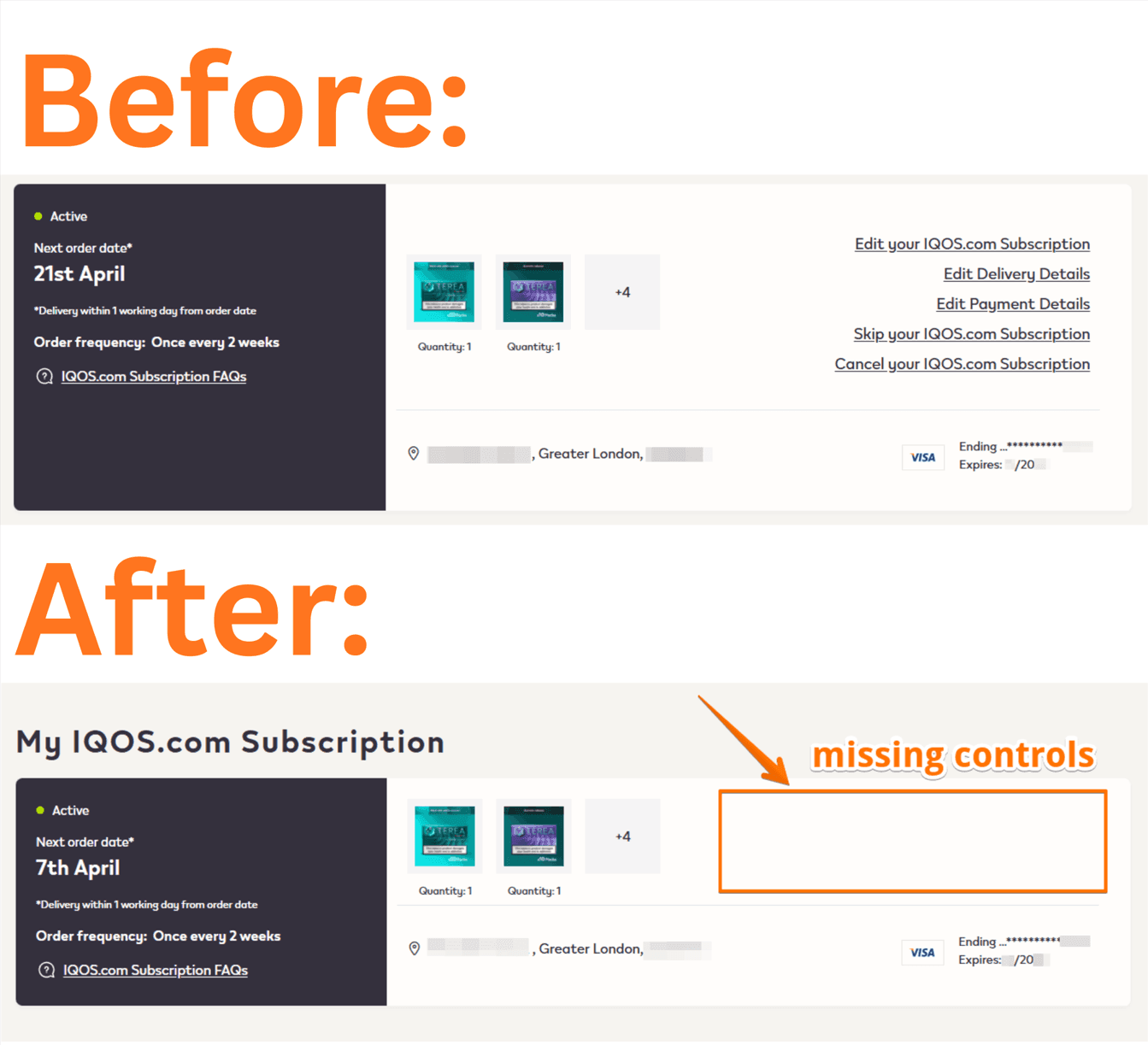
I explored the entire account. Gave up and went to the support chat on the website. The chatbot told me I could not make any changes after the cutoff time. I did not understand what cutoff time it was referring to, so I waited for a live agent to join the chat. However, the live agent told me the same thing: I could not make any changes after the cutoff time shown on the subscription management page. I could not find it. The agent told me the cutoff time is three days before the next order processing date.
Frustration. Restricting the customer's freedom of action is always a poor experience. Why can I not make basic changes? Cancel my subscription if I want to. Or change the payment method. The customer has set aside their time when they have it. And they hit a restriction that is not even obvious, one that demands considerably more time to work out, so they need to come back later and try again. Other channels are unlikely to put this kind of obstacle in the customer's journey.
Non-subscription orders can be processed on the day they are placed. And we already know that, even within the subscription, you can change the date of the next order to [today] and the order will still be confirmed and processed. So, operationally, it works without breaking the system.
But you cannot change A THING within three days of the next order being processed. I do not understand why a more loyal customer, one who has subscribed and is willing to remain a customer on a regular, long-term basis, should be punished for being loyal and valuable to the brand.
*Honestly, this section of the study was meant to end earlier. I wanted to resolve my situation easily and forget about it. However, IQOS kept pulling me back into this loop, and I had no choice but to unpack this case to the very end.
And so, with fewer than three days until the next order processing date, and unable to make any changes to my subscription, I wanted to cancel the upcoming order. I asked the chat agent what would happen if I block the IQOS charge on my bank card, so that when the order processing moment arrives, IQOS would be unable to take payment, and that would be the reason to cancel that particular order. In response, I received the following solution:
You can return it for a refund once you have received and adjust the subscription then. Just contact us once you receive the parcel and we will create a return label for you then.
This is free for me, with next-day delivery service. Meaning IQOS pays for shipping both ways on that order. Fine, that is their business. It looks like a show of loyalty towards me. But I would still need to print a label, meet the courier, or walk to a drop-off point.
I want to highlight the loss points for all parties involved:
- PMI paid for the development and implementation of this solution.
- PMI paid for return shipping and received no sale.
- The customer paid with their time and reduced their loyalty due to the complexity of the process.
- PMI paid for customer support in the chat.
One operational restriction drags these costs behind it. Is it worth it, given that a different implementation could generate revenue rather than expenses?
Since I was still trying to find a way to avoid spending time on returning sticks I did not need, I remembered that when I place one-off orders, I have a Cancel button before my order is dispatched. I used it once or twice when I made a mistake in what I ordered. I was wondering whether I would have the same button for a subscription order. When I received a notification from my bank about a charge from IQOS, I went to my subscription order history, saw the new order that had not yet been dispatched, and spotted the much-desired "Cancel" button.
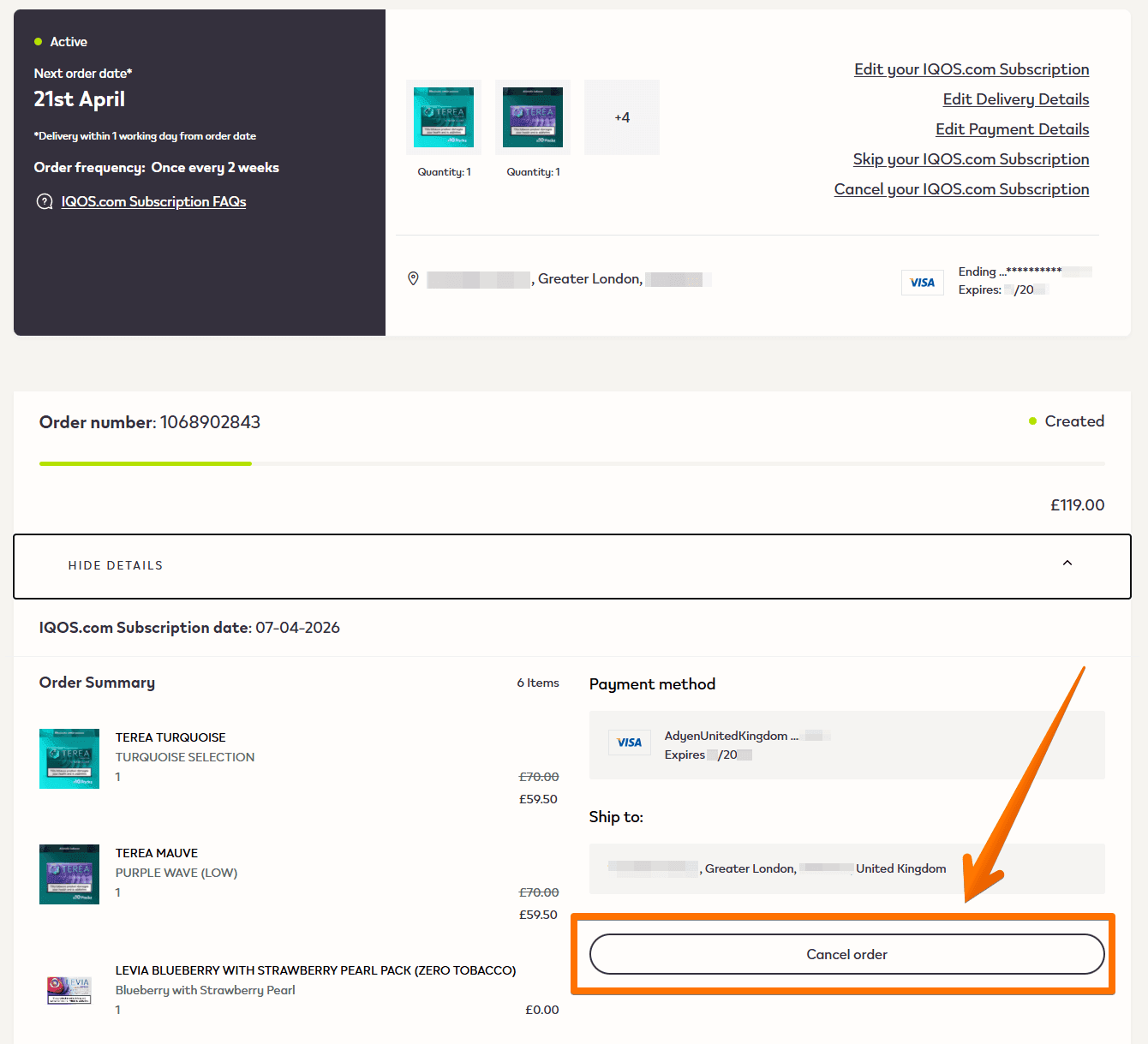
I pressed it. Saw the order update to a "Cancelled" status. Received an email confirmation that the order had been cancelled. Felt relieved that I had managed.
This customer experience is neither consistent nor intuitive. Everything, including the support agent, convinced me that I could not cancel an order that had not yet been dispatched. And it turns out I can. If, of course, I am persistent enough. I am fairly certain that the IQOS business model is not one in which customers should have to be persistent and diligent just to hand over their money and be happy.
That was not all.
A few minutes later, I received a second email:
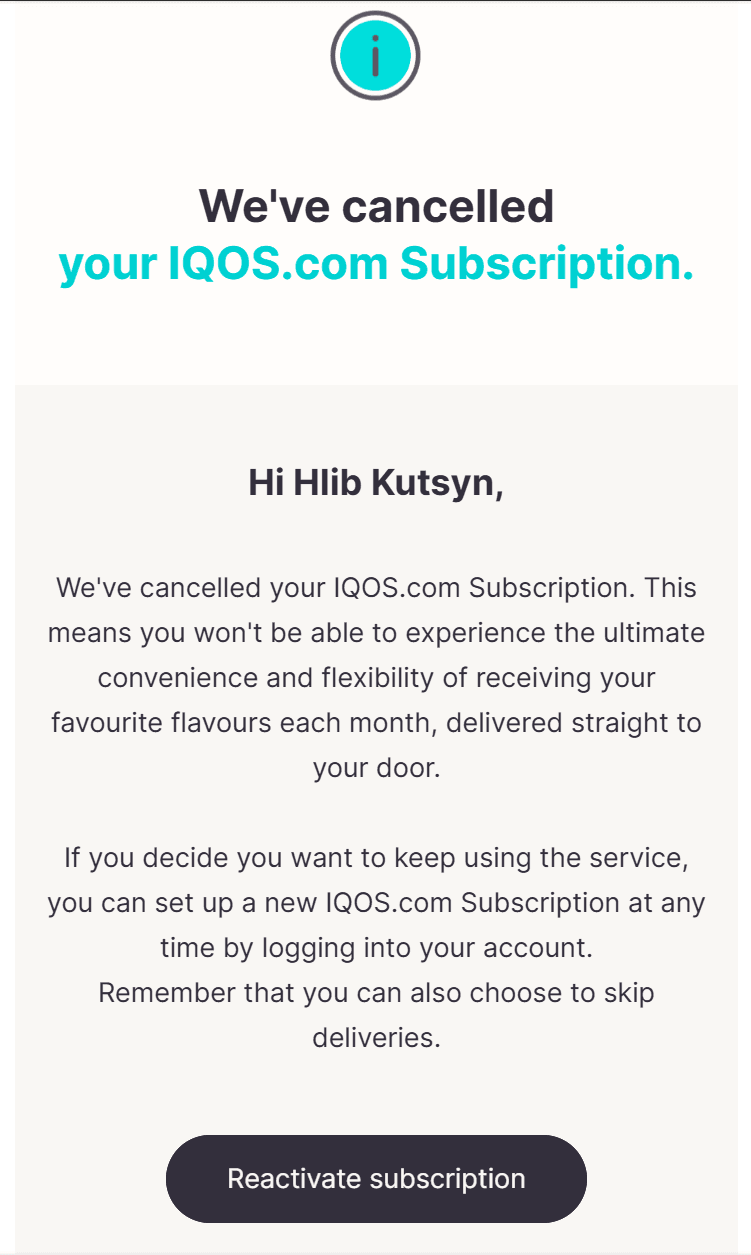
Following the cancellation of a single order, which is what I was after, PMI cancelled my entire subscription. Why? What did I do wrong? The "cancel subscription" and "cancel order" buttons are two different buttons located in different places. I did not confuse them. Yet I won't be able to experience the ultimate convenience and flexibility now. That is what IQOS wrote to me in their email. And no, I can see this is not a ban for violating the rules, because in the very same email, IQOS offers me the option to reactivate my subscription. If I had set out to write a review of the service, it would hardly be complimentary, and it would hardly mention ultimate convenience and flexibility. All the effort and money invested in acquiring new customers for the company's own D2C have been undone by the business itself through the cancellation of the subscription.
What this is really about
This is a textbook example of a service designed around the operational convenience of the business, not around actual customer behaviour. A subscription is a retention tool. But when a subscription creates more friction than it removes, the customer does not subscribe. They simply add consumables to their weekly grocery delivery from an online supermarket. Or pop into the shop around the corner. Or order from anywhere else that does not require them to restructure their life around someone else's logistics.
And then, somewhere inside the business in a quarterly report, a line appears: "low subscription adoption rate". And everyone is surprised.
I do love a simple solution, but not where 'simple' means 'we stopped at the first solution that worked for the business'.
There is a concept in urban planning called a "desire path" – a trail worn into the grass where people actually walk, as opposed to where the paved walkway tells them to walk. You have seen it: a pavement turns at a precise 90-degree angle, and right next to it, there is a diagonal strip of trampled earth where everyone cuts the corner.
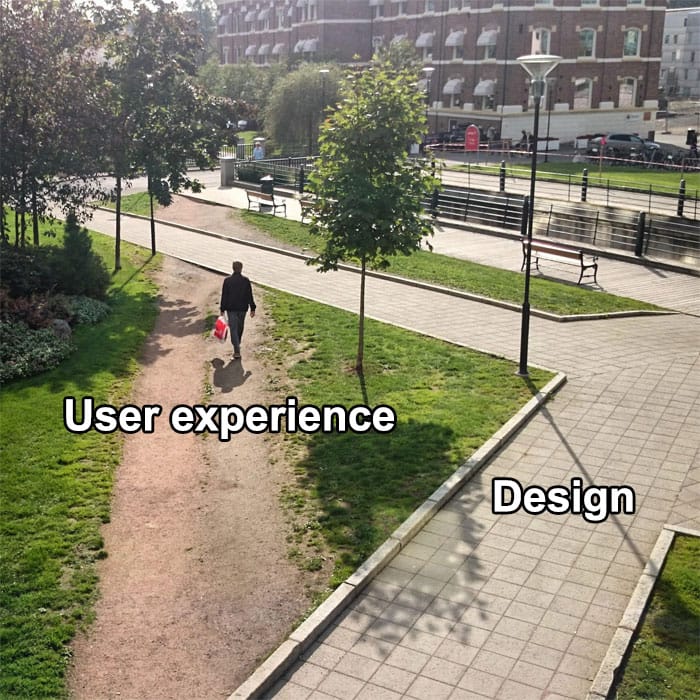
The customer will always find their own path. The only question is whether you design for it or stand there watching them trample your lawn and buy elsewhere.
How would I build this service
*Before answering this question, I want to note upfront that I will not be challenging the chosen strategy, which nearly entirely ignores existing customers, because I do not have the internal business data on which it would be fair to base a strategic judgment. Although my experience convinces me that forgetting about existing customers is not an option, because sooner or later, they will go where someone cares about them.
From a Customer Experience perspective
For the buyer, a more flexible service becomes more personalised and more convenient. These factors, in turn, create a dependency on the service and turn the buyer into a brand advocate among their circle.
So, without question, the buyer should be allowed to choose any delivery frequency that can be replicated by one-off orders. In the case of IQOS, that means anything from one day to once every 2-3 months.
In the interface, this is easily implemented as "every 1-30 days/weeks/months". At the same time. As a minimum, it is important to add several ready-made one-click presets that cover the top 5 recurring patterns among existing buyers. The best solution is personal and tailored to the individual customer's behaviour. The business certainly has this data.
It is also important to add a reminder notification for the buyer, letting them know that their next order will be processed in [X] days and delivery is estimated in [Y] days. Beyond being polite and showing care for the customer, such a notification also provides a premium level of service, giving the client the option to adjust or skip a delivery, while reminding them of their active subscription.
The cutoff time should also be no different from what can be replicated with one-off orders, so there is little reason to keep it at all. However, if there is a business need I cannot see from the outside, the cutoff time and date must be displayed very prominently to the customer. T&C is not the place to hide it.
From a business perspective
Operationally, nothing changes for the business. However, the model I described above also opens up additional opportunities, such as reducing delivery costs. Knowing when the customer expects their delivery allows the business to retain control over the choice of delivery service. As a result, for subscription orders, in most cases, Royal Mail services with a 2-3 day delivery window can be used instead of Next Day Delivery by DHL and DPD. For the customer, the delivery date matters more than the date the order is processed.
Expected outcome
- A significant increase in the number of subscribers.
- Growth in new customer acquisition through brand advocacy among the loyal audience.
- A substantial increase in customer loyalty to the company's own D2C sales channel.
- Reduced logistics costs.
Love your existing customers and do not create obstacles when they are trying to give you their money. A subscription service should be simpler and faster than the 2 minutes the customer would spend buying consumables at the corner shop on their way home from the office. Simple and transparent operations not only reduce barriers but also increase customers' trust.
Am I supposed to add a disclaimer here that I do not promote tobacco use, which damages your health and causes addiction? I feel like I do. So there it is.