Why digital marketing is not ecommerce, and what it costs when businesses confuse the two
2026-04-23
Handing ecommerce to the marketing team is one of the most persistent structural errors in companies with an online channel.
- Ecommerce
- Marketing
- Leadership
- Digital Transformation
Today, I bring you an observation about one of the most persistent structural errors I keep seeing in companies with an online channel: handing ecommerce to the marketing team, and then being surprised that the commercial outcomes do not materialise.
I have spent close to two decades in this industry, across the UK, the US and the EU. I have built ecommerce teams from scratch, inherited dysfunctional ones, and worked inside organisations ranging from small DTC brands to enterprise operations with thousands of staff and millions of transactions a year. One pattern recurs more than any other. When ecommerce is run by a marketer, the business leaves significant commercial performance on the table.
Not because marketers are not capable people. Because ecommerce is not a marketing function.
Let me start with the analogy that makes this almost embarrassingly obvious.
The physical shop test
Nobody, in any sensible retail business, asks the marketing director to run Selfridges. Or Harrods. Or the local Waitrose. The marketing director has a clearly defined remit: brand, communications, campaigns, PR, loyalty, events, sponsorships. Their job is to make people want to come through the door and to keep the brand relevant in customers' minds.
Once customers are in the shop, an entirely different set of functions takes over. Buying and merchandising decide what is on the shelves, when, and at what price. Visual merchandising decides how it is displayed. Store operations manage staff, stock, tills, cleanliness and security. Customer service handles queries and complaints. IT keeps the tills running, the card terminals working, and the back-office systems synchronised. Finance watches the margin. Legal watches compliance. Above them all sits a commercial director, a general manager, or at a higher level, a trading director or COO, whose job is to coordinate these disciplines and own the commercial outcome.
Now picture the same shop online.
The website is the shop floor. The product catalogue is the shelves. The checkout is the till. Order management is stock control. Customer service is, well, customer service. Photography and content are the visual merchandising. Delivery and returns are back-of-house operations. Payment and fraud are the card terminals. Site reliability is the lights staying on.
Marketing is still one function. It still drives people through the virtual doors. But the shop itself is not marketing. It is a dozen other disciplines stitched together, running twenty-four hours a day, scaled across as many countries as the business sells in, and subject to a constant stream of platform updates, policy changes and technical dependencies.
And yet, somehow, the assumption that ecommerce is a senior marketing role persists. It is why I keep seeing job descriptions for "Director of Digital" that list SEO, paid media, email and social as the main responsibilities, then casually mention "P&L ownership" and "site operations" near the bottom. The job being described is two jobs, wrapped in the title of the one that is easier to hire for.
What ecommerce actually is
Ecommerce, as a function, integrates roughly ten disciplines. Every business organises them slightly differently, but the disciplines themselves do not change.
- Technology and platform. Commerce platform (Shopify Plus, Magento, Salesforce Commerce Cloud, commercetools, custom build), plus the integrations that keep the business running: ERP, PIM, OMS, WMS, CRM, CDP, payment gateways, tax engines, analytics tools. Performance, reliability, security. Internal development teams or platform partners.
- Merchandising and trading. Product assortment, category page construction, pricing strategy, promotional calendar, stock allocation across channels, weekly trading rhythm, performance against trading targets. In physical UK retail, this has always been a senior discipline. In ecommerce, it is often underweighted or folded into someone else's job.
- Digital marketing and acquisition. Paid search, paid social, SEO, email, affiliate, programmatic, influencer, retargeting. The discipline that drives qualified traffic to the site.
- CRO and experimentation. A/B and multivariate testing, personalisation strategy, conversion-funnel optimisation, experiment hygiene, and statistical rigour. The discipline that turns traffic into revenue.
- UX, design and content. Information architecture, product photography, copy, category content, editorial, visual hierarchy, accessibility. The discipline that makes the site understandable and usable by actual humans.
- Operations and fulfilment. Order management, inventory accuracy, 3PL relationships, warehouse performance, carrier management, delivery SLAs, returns processing, reverse logistics.
- Customer service and CX. Pre-sales and post-sales support, complaint handling, proactive engagement, Voice of the Customer programme, the feedback loop that closes back into product data, operations and tech.
- Analytics and data. GA4, product analytics, commercial reporting, attribution, cohort analysis, customer segmentation, forecasting, dashboards, and the data warehouse itself.
- Finance and commercial. Pricing strategy, margin management, promotional ROI, channel P&L, budgeting, forecasting, and building the business case for every material investment.
- Legal and compliance. Data protection (UK GDPR, EU GDPR, CCPA), consumer protection law, accessibility compliance (WCAG and, for EU markets, the European Accessibility Act), terms and conditions, cookie policies, product safety, cross-border tax and trade.
Digital marketing is one of these ten. No more. In a well-run ecommerce business, it is probably not even the biggest one by headcount or budget.
Why marketing-led ecommerce goes wrong
This is not theoretical.
Paid media budgets expand to hit revenue targets that could be met more cheaply by fixing the experience. Customer acquisition cost rises each quarter because the site's conversion rate is not improving.
Product data sits in an eternally half-finished state. Attributes are incomplete, images are inconsistent, copy is written by whoever had a spare afternoon. Category pages cannot be filtered properly because nobody owns the data model.
The checkout has three preventable friction points, and nobody has fixed them in 18 months because "it is a tech issue," and tech reports into a different part of the organisation.
Stock is out of sync with the site. Customers order products that are not actually available. Cancellation rates creep up. So does the refund workload.
Customer service is firefighting the same preventable issues month after month. Nobody is closing the loop back to merchandising, operations, or tech because nobody has been told it is their job.
Merchandising decisions get made by whoever shouts loudest in the weekly meeting. There is no trading rhythm, no commercial calendar, no accountable forecast.
Analytics reports focus on campaign performance and vanity metrics. Conversion rate by category, stock availability's impact on revenue, checkout funnel drop-off: nobody is systematically looking at these because the leader in the room is not trained to ask.
Everyone thinks they own the customer experience. In practice, nobody does.
The common thread is simple. A marketing-trained leader naturally prioritises the discipline they understand best. The other nine get treated as either support functions or somebody else's problem. The commercial outcome suffers.
What an Ecommerce Director or VP actually does
The role exists to integrate. To sit above the individual disciplines, set the strategy, hold the P&L and make sure the ten functions pull in the same direction rather than against each other.
In practical terms, an effective ecommerce leader spends their time on four things.
Commercial ownership. The ecommerce leader owns the online P&L: revenue, margin, customer acquisition cost, lifetime value, contribution to group profit. They make trade-offs among channels, markets, and discounting versus full-price trading. They decide where the budget goes.
Strategy and roadmap. Which markets do we enter next? Which technology investment is coming up? What is the three-year view on customer experience, internationalisation, subscription or marketplace expansion? The ecommerce leader frames these questions, builds the business case and drives the execution.
Cross-functional integration. They run the trading rhythm. Weekly performance review with marketing, merchandising, operations, customer service, tech and finance at the table. Monthly business review. Quarterly planning. Without someone orchestrating this, each discipline optimises in isolation and the customer experience fragments.
Team and capability. Which roles do we need? When do we hire them? Where are the skill gaps? Who coaches whom? Just as important as the numbers, and routinely neglected in businesses that have not yet matured into a proper ecommerce operation.
Everything else flows from those four.
How the team should be structured, by business size
There is no universal answer. The right structure depends on revenue, product category, business model, geographic footprint and the in-house versus outsourced operating model. That said, the following shapes work in practice, and each represents a stage most businesses pass through on the way up.
Small business (under £5 million online revenue, team of up to 10)
At this stage, a dedicated ecommerce director is usually overkill. The operating model looks more like this.
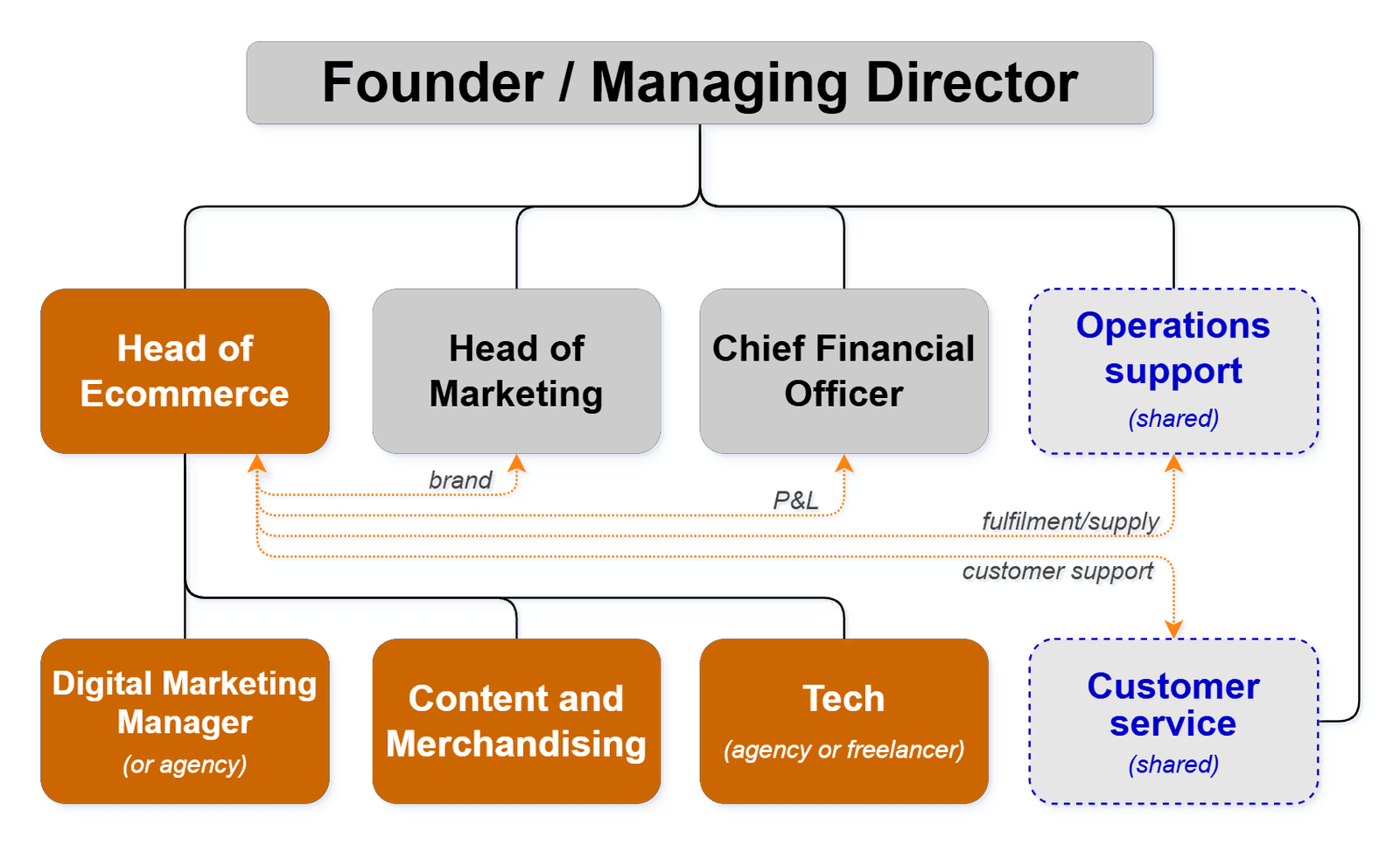
Roles:
- Head of Ecommerce or Ecommerce Manager acting as a generalist, responsible for the site day-to-day, the P&L in aggregate, and the relationships with external partners.
- Digital Marketing Manager or a specialist agency for paid media and email.
- Content and Merchandising hybrid for product data, photography coordination, category pages and weekly trading decisions.
- Operations support is usually shared with the wider business.
- Customer service is also shared.
- Tech is typically handled by an agency or a freelancer, with perhaps one in-house developer as the team grows.
KPIs: Straightforward at this tier. Revenue, conversion rate, average order value, customer acquisition cost, repeat rate, gross margin. One clean trading dashboard for the whole team to look at. The Head of Ecommerce reports to the founder, the Managing Director or the Chief Commercial Officer, depending on the shape of the business.
Interaction with other departments: Informal, because the whole team is small. Weekly trading meeting of forty-five minutes, monthly deep dive. External partners deliver specialist work under clear briefs. The Head of Ecommerce is the translator between commercial, finance, operations and the rest of the business.
The trap at this stage: Hiring a digital marketing agency or a performance marketing manager as the first hire. It should almost always be an Ecommerce Manager first. Without someone owning the site, every pound of ad spend pours into a leaky bucket.
Mid-sized business (£5 million to £50 million online revenue, team of 10 to 30)
This is where the structure starts to look like a proper ecommerce function. A typical shape.
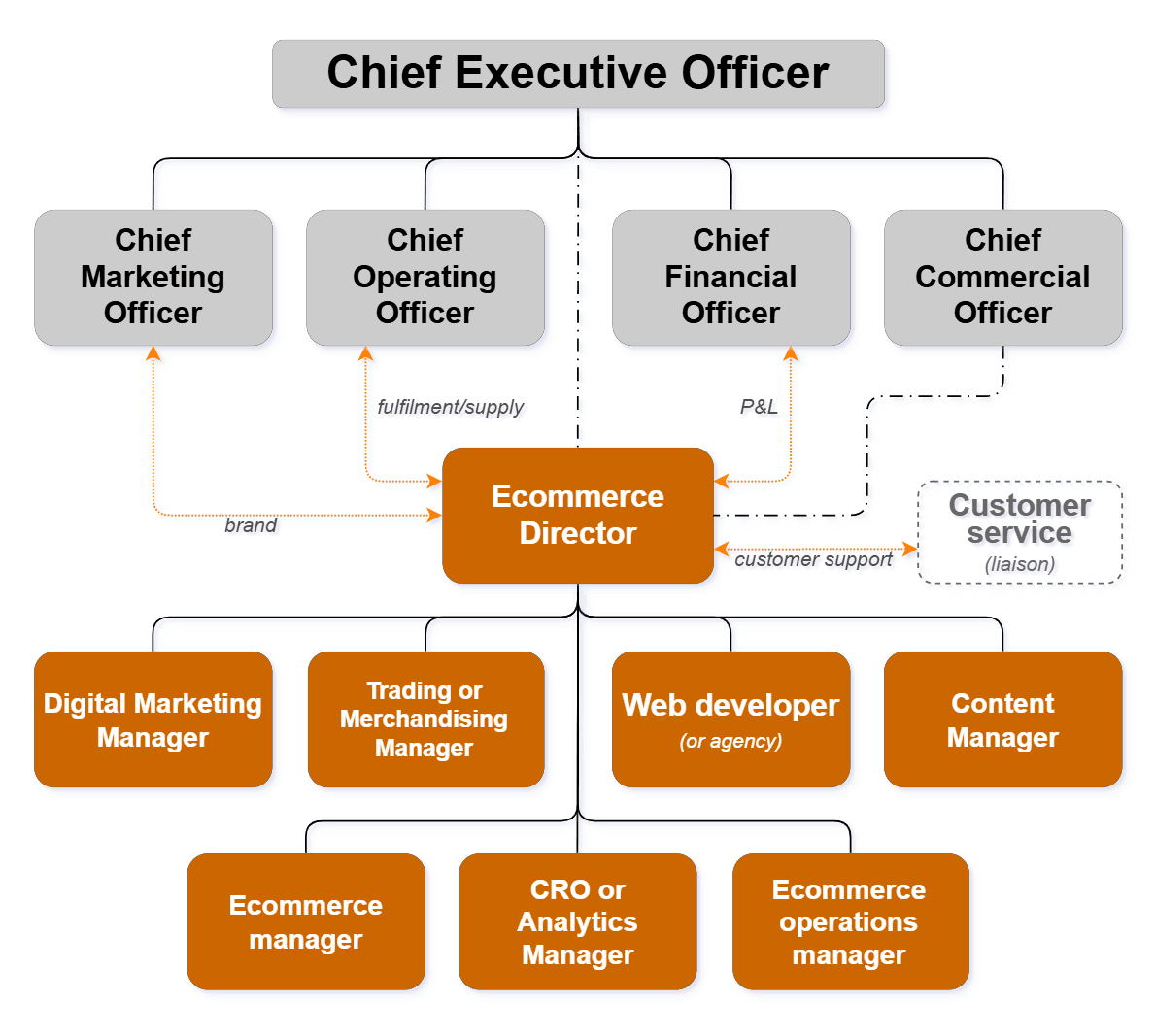
Roles:
- An Ecommerce Director or Head of Ecommerce, reporting to the CCO or MD, depending on how the business is organised, owns the online P&L, the trading rhythm and the team.
- Ecommerce Manager for site operations, product data, platform relationship, and day-to-day coordination.
- Trading or Merchandising Manager for commercial calendar, pricing, promotions, category performance and weekly trading.
- Digital Marketing Manager or Performance Marketing Manager for paid media, SEO, email and attribution.
- Content Manager for photography, copy, category content and editorial.
- CRO or Analytics Manager for the testing programme, reporting and insights.
- Ecommerce Operations Manager for fulfilment, stock, 3PLs, delivery and returns.
- Customer service usually sits elsewhere in the org but has a named ecommerce liaison.
- Tech is a dedicated developer or a strong relationship with IT, supplemented by the platform partner.
KPIs per role:
- The Trading Manager owns category and product-level performance, weekly sell-through, stock cover, promotional ROI.
- The Digital Marketing Manager owns customer acquisition cost, return on ad spend, channel contribution, email revenue share.
- The CRO Manager owns uplift from the testing programme and the statistical credibility of every reported win.
- The Ecommerce Operations Manager owns the delivery SLA, return rate, fulfilment cost per order, and on-time dispatch.
- The Content Manager owns content coverage, product page completeness, and the time-to-live for new product launches.
- The Ecommerce Manager owns site availability, page speed, product data accuracy and platform releases.
- The Ecommerce Director or Head of Ecommerce sits above all of them, with responsibility for the P&L: total online revenue, gross margin, and contribution to group profit.
Interaction with other departments. Cross-functional coordination becomes a formal discipline at this tier. Weekly trading meeting, chaired by the Head of Ecommerce, with trading, marketing, operations and analytics around the table. Monthly business review with wider stakeholders, including finance, supply chain and customer service. Quarterly roadmap reviews. A shared trading dashboard. Clear ownership lines between merchandising and marketing, between operations and tech, between customer service and the product team. The Head of Ecommerce becomes the single point of contact for the board on online performance.
The trap at this stage. Senior management is still treating ecommerce as "digital marketing at scale" and cutting the operational or commercial roles that do not feel immediately linked to traffic. That is how teams end up with four people in performance marketing and no one owning the checkout.
Enterprise business (over £50 million online revenue, multi-market, 30 or more people)
At enterprise scale, the shape expands. A VP or Director of Ecommerce sits at the top, reporting to the CCO, the Chief Digital Officer, or directly to the CEO, depending on the organisation. Underneath them sits a senior leadership team.
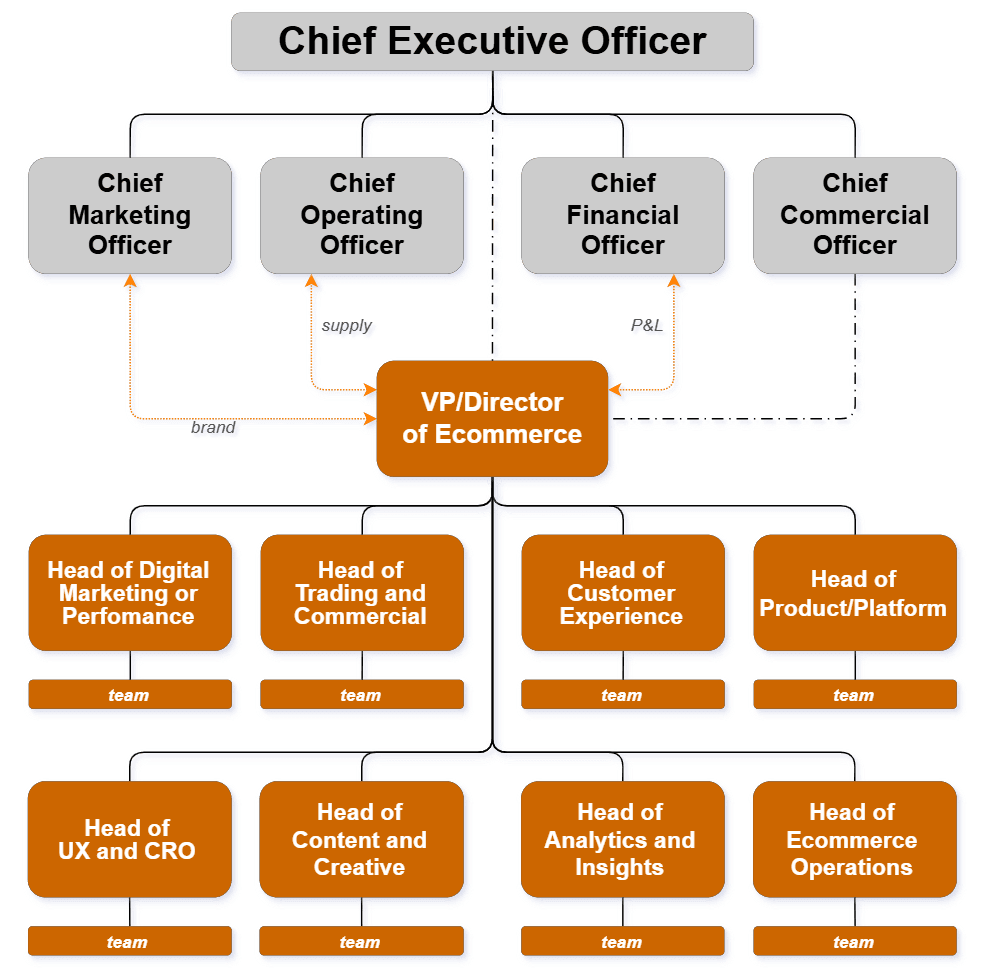
A reasonable shape includes these roles:
- Head of Trading and Commercial, owning the commercial calendar across categories, pricing strategy, promotional performance, and category-level P&L, with a team of merchandisers and trading managers underneath.
- Head of Digital Marketing or Performance, owning acquisition, attribution, channel strategy and the marketing technology stack, with paid media, SEO, email, affiliate and CRM teams.
- Head of Ecommerce Operations, owning fulfilment, logistics, stock integrity, returns and operational SLAs.
- Head of Customer Experience or CX, owning the customer service function, Voice of the Customer, and increasingly the end-to-end customer journey.
- Head of Product or Platform, owning the technology roadmap, the platform itself, integrations and the relationship with internal engineering or external partners.
- Head of UX, CRO and Experimentation, owning site experience, research, testing and personalisation.
- Head of Content and Creative, owning product content, editorial, photography and creative production.
- Head of Analytics and Insights, owning reporting, data science, customer analytics and decision support.
- In multi-country operations, a local ecommerce lead per major market, reporting to a matrix of the VP of Ecommerce and the local country MD.
Team sizes. Typically, anywhere from 40 to 200 or more, depending on category, geography and the balance between in-house work and external partners. At Pandora-scale, a single market can have 30 or 40 ecommerce staff on its own.
KPIs per function. Layered. At the top, the VP owns total online revenue, contribution margin, customer acquisition cost payback, customer lifetime value, and a handful of strategic KPIs tied to the three-year plan. Each Head owns a portfolio of metrics:
- The Head of Trading owns sell-through, full-price mix, markdown efficiency and category-level margin.
- The Head of Digital Marketing owns blended CAC, ROAS, channel contribution and first-purchase retention.
- The Head of Operations owns OTIF delivery, stock accuracy, fulfilment cost per order and return rate by category.
- The Head of CX owns Net Promoter Score, Customer Satisfaction, first-contact resolution and contact rate per 100 orders.
- The Head of Product owns uptime, Core Web Vitals, release cadence, and platform health.
- The Head of UX and CRO owns experiment velocity, win rate, and uplift attributed to testing.
- The Head of Analytics owns data reliability, time-to-insight, and the quality of commercial reporting.
Each team below has its own scorecard, and the discipline is to ensure every metric rolls up coherently into the top-line numbers the business is steered by.
Interaction with other departments. This becomes the VP's full-time job. Daily stand-ups during peak trading periods. Weekly trading review with the leadership team. Monthly cross-category business review. Quarterly planning, annual strategy cycle. Regular alignment sessions with product, supply chain, retail, finance, legal, data and group marketing. In a matrix organisation, the VP also manages horizontal relationships with regional MDs, the group CMO and the CFO, and is often part of the executive team itself.
The trap at this tier. Structure drift. A Head of X is hired to plug an urgent gap; the org chart expands around them, and six months later, the VP finds their ecommerce function has duplicate roles, conflicting mandates, and unclear reporting lines. The answer is not more structure. It is a tighter definition of what each function owns, where the handoffs sit, and how decisions get made.
Cross-functional interaction, at any scale
Regardless of company size, certain interactions are always critical. Getting them right is the ecommerce leader's job. Getting them wrong is what most often causes an ecommerce function to underperform its potential.
Ecommerce and broader marketing. Ecommerce needs to know which campaigns are going live, when, and with what creative. Marketing needs to know what is in stock, what the commercial calendar looks like and where the site is weakest. Misalignment here leads to campaigns pointing at unavailable products and category pages that were never prepared for the spike.
Ecommerce and merchandising or buying. Ecommerce needs accurate, complete, timely product data and honest forecasts of what is coming in and going out. Buying needs visibility on online demand signals, bestsellers, search trends and seasonal patterns that might not show up in offline data. The worst version of this relationship is adversarial. The best version is a joint forecast and a shared trading calendar.
Ecommerce and operations or supply chain. Accurate stock visibility, reliable delivery promise logic, clean returns data. The online customer judges the entire business by the delivery experience. Operations is what turns the click into a sale that does not become a refund three days later.
Ecommerce and customer service. Service reports into ecommerce in some companies and into operations in others. Either way, the handshake matters. The top ten contact drivers each week should be the starting point for site improvement, product data fixes, and process changes. Without that feedback loop, you are re-solving the same problem every month.
Ecommerce and IT or engineering. The platform, the integrations, the data pipelines. A healthy relationship means a shared roadmap, clear prioritisation, and a technical debt plan that is actually executed. An unhealthy one means tickets sitting for months, and ecommerce getting blamed for issues it cannot fix.
Ecommerce and finance. The P&L, the business case for every material investment, the pricing and margin conversations. Finance is the function that most often catches nonsense in the ecommerce narrative before it reaches the board. A smart ecommerce leader treats finance as an ally, not a blocker.
Ecommerce and data or analytics. The shared truth about what is working. If analytics reports into marketing, ecommerce gets a marketing-flavoured view of performance. Ideally, analytics is neutral and reports to the same leader as ecommerce, or to a higher-up in the organisation.
Ecommerce and retail, where applicable. In omnichannel businesses, the relationship between ecommerce and physical stores is the single most politically loaded interaction in the company. Attribution of sales, credit for customer acquisition, stock allocation between channels, click-and-collect economics, and returns processed in-store from online orders. Getting this right is a board-level conversation, not something the ecommerce director can fix on their own.
What to do with this
If you are a CEO or an investor looking at an underperforming ecommerce business, the first question is not about traffic or conversion. It is about who owns ecommerce as a commercial function, what their background is, and what their remit actually covers. If the answer is "the marketing director, alongside the rest of their job", you have probably found the main reason the numbers are not where you want them.
If you are an ecommerce leader trying to make the case internally for a proper structure, the language that tends to work with finance and the board is the language of P&L ownership, customer acquisition cost payback, and cross-functional coordination. The physical retail analogy I opened with also tends to land well. Most boards intuitively understand that a shop needs a general manager, not just a marketing director. The same logic applies online. It just took the industry a while to catch up with that.
And if you are a marketer being asked to run ecommerce, push back. Or at least negotiate the mandate, the budget and the team shape you will need. Otherwise, you will spend eighteen months being accountable for a commercial outcome you do not have the levers to influence. I have seen enough careers damaged by that pattern to keep writing about it.